NCWRPC News Spring 2014 – Issue 53
Northwoods NiiJii Enterprise Community, Inc. Comprehensive Strategic Plan – 2014
The Niijii Community is defined by the people who live and work there; the houses and businesses; the parks and cultural features. There are three tribes affiliated with the NiiJii Enterprise Community; they are the Lac du Flambeau Band of Lake Superior Chippewa, the Menominee Indian Tribe of Wisconsin and Sokaogon Chippewa Community (aka Mole Lake Band of Lake Superior Chippewa Indians), see MAP 1. The comprehensive plan provides guidance to the NiiJii Enterprise Community when making future decisions on key community elements. How a community changes, how that change is perceived and how change is managed are the subjects of community comprehensive planning. The plan will provide goals, objectives and policies to successfully grow and advance the communities in five key elements: Population and Housing; Economic Development; Utilities and Transportation; Agriculture, Natural Resources and Cultural; and Land Use. Goals and objectives include key livability principles ensuring future growth that accommodates community member’s needs and desires ultimately working towards a better more sustainable life for the NiiJii Enterprise Community.

NCWRPC News Winter 2014 – Issue 52
Annual Report 2014
The Annual Report is prepared to provide interested local, state, and federal
officials as well as citizens with an overview of the activities undertaken by the
NCWRPC over the last year. The report highlights our five core work areas:
• Economic Development
• Geographic Information Systems
• Intergovernmental Cooperation
• Land Use, and
• Transportation
In addition, the report meets the requirements as outlined in Wisconsin Statute
66.0309(8)(b) for annual report preparation. This is our 47th Annual Report.
With your continued support, we look forward to another successful year in
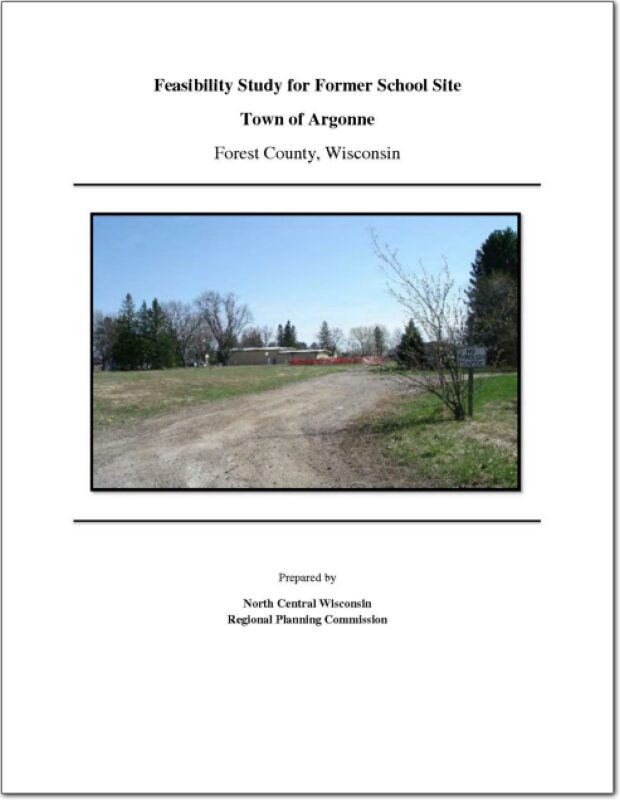
Feasibility Study for Former School Site Town of Argonne
The Town of Argonne was founded in 1887 when the Soo Line railroad built a depot. Today, the community has a population of just over 500 people. The center of the community is located at the intersection of State Highway 32 and 55. The community’s town hall, fire department, post office, community building and major business area is located within blocks of the intersection. The rail line is no longer active.

Comprehensive Economic Development Strategy 2014
An assessment of economic development activities of the North Central Wisconsin Regional Planning Commission over the last decade and the past year. The report’s seven sections describe the CEDS Committee, Past Year’s Activities, the Physical Region, Changes in the Region’s Population, Changes in the Region’s Economy, a Regional Development Strategy, and an Economic Development Work Plan. Also included is a list of potential public works projects.

2015 Comprehensive Economic Development Strategy – Executive Summary
The North Central Wisconsin Regional Planning Commission (NCWRPC) is designated as an Economic Development District (EDD) by the U. S. Department of Commerce, Economic Development Administration (EDA). Current members of the EDD are Adams, Forest, Juneau, Langlade, Lincoln, Marathon, Oneida, and Vilas Counties, as well as parts of Portage and Wood Counties. The EDA provides Financial assistance to designated districts in part, for the purpose of developing a Comprehensive Economic Development Strategy (CEDS), the Region’s economic roadmap to diversify and strengthen the regional economy

NCWRPC News Fall 2013 – Issue 51
Oneida County Comprehensive Plan 2013
This is the first of nine elements that comprise the Oneida County Comprehensive Plan. The plan provides detailed information on the county and also includes all twenty towns and the City of Rhinelander. Oneida County is located in northeastern Wisconsin and is bounded on the north by Vilas County, on the east by Forest County, on the south by Lincoln and Langlade counties, and on the west by Price County. The county is a predominantly rural area with a large proportion of its land in forests, wetlands, and agriculture. Residents and visitors from both near and far utilize its more than 1,100 lakes and expansive natural areas for recreational purposes. The City of Rhinelander is the county seat and largest community in the county with a population of about 8,200. See the planning context map.