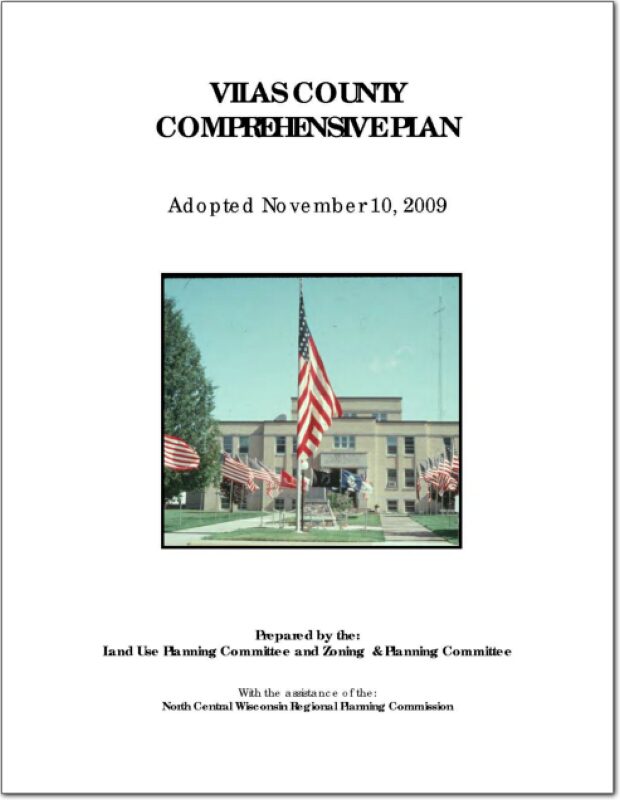
Vilas County Comprehensive Plan 2009

In 1999, the Governor signed into law Wisconsin Act 9, the Budget Bill, containing substantial revisions of existing planning related statutes and established the current comprehensive planning law (§66.1001 WI Stats.). Basically the law provides a definition of a plan, and should address demographic trends, natural resources, housing, transportation, economic development, and land use, among others. In addition, the law requires consistency between the local plan and local implementation tools of official mapping, subdivision ordinances and zoning ordinances; and requires public participation. Most important, is that it maintains that the process be locally driven so all local units of government decide their own future.
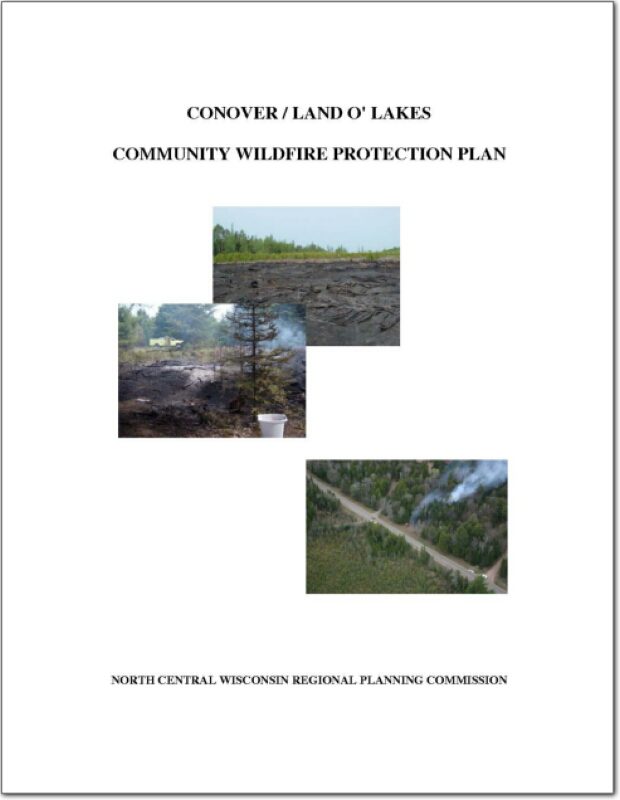
Conover/Land O’ Lakes Community Wildfire Protection Plan – 2009

This plan is a Community Wildfire Protection Plan (CWPP) as defined in Title 1 of the Healthy Forest Restoration Act (HFRA) of 2003. The purpose of this CWPP is to provide the Towns of Conover and Land O’ Lakes, local fire departments, Vilas County, the Wisconsin Department of Natural Resources (WDNR), and the U.S. Forest Service (USFS) with information and tools to help them reduce potential risks associated with wildfires and to collaboratively identify wildfire mitigation actions that will provide solutions to address the impacts of wildfire hazards. The plan will also assist the citizens of the two towns to prevent wildfires and be better prepared to deal with wildfire hazards. The plan develops strategies aimed at protecting life, property, and the natural environment.

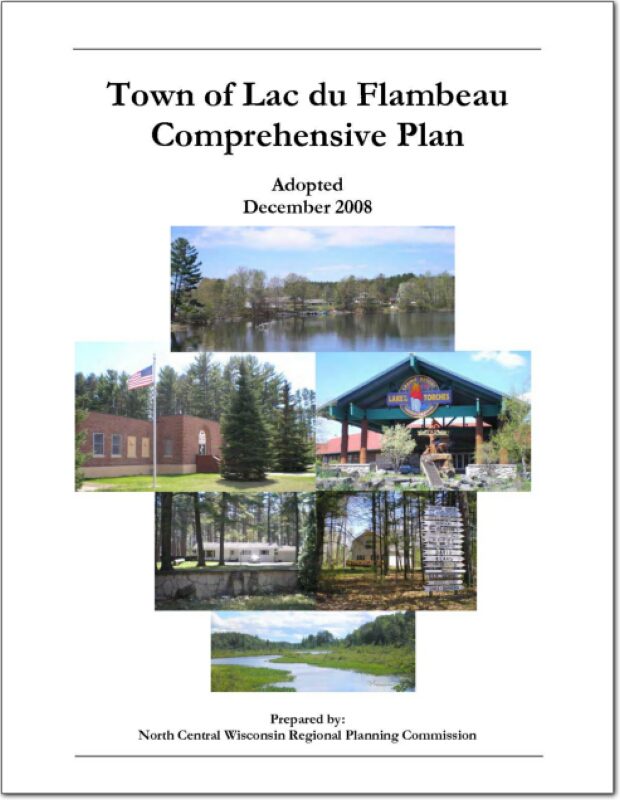
Town of Lac du Flambeau Comprehensive Plan – 2008

The Town of Lac du Flambeau Comprehensive Plan— explores potential issues that may have an effect on the development of the Town over the 20-year planning period of the plan. As required by the state’s comprehensive planning law [§66.1001(2)(a) Wis. Stats.], this chapter contains trends and forecasts with jurisdictional comparisons for some basic demographics including: population, households, employment, age, education, and income. Although forecasts should typically cover the 20-year planning period, in some cases, the only acceptable sources had lesser time periods for their forecasts. Official sources are used for data and forecasting, including the WDOA Demographic Service Center, and the U.S. Census Bureau.