Langlade County Scout Camp Concept Plan – 2019


The 522-acre camp was closed in 2015 and became available. The County researched and evaluated acquiring the site for a variety of potential uses. They then applied for funding from the Department of Natural Resources through the Knowles-Nelson Stewardship Land Acquisition program to help fund the purchase. The acquisition of the 522-acre site cost a total of $1.35 million, with $730,000 being provided from the Knowles-Nelson Stewardship Land Acquisition Program. Map 2: Site Boundary displays the boundaries of the entire site.

The County plans to utilize the site as a campground and to open public access to the two lakes on the site. The Langlade County Forestry Department will also manage the site’s wooded areas for timber production. The campground will be developed in phases over time and will provide for tent, cabin, and RV camping. This concept plan was prepared to provide a general development plan for the site, and to provide some general recommendations for the site.

On December 15, 2017, Langlade County purchased the Robert S. Lyle Scout Reservation, which is located east of Elcho in the northeast section of the County, from the Three Harbors Boy Scout Council of Milwaukee, Racine and Kenosha counties. For a representation of where the camp is located within Wisconsin, see Map 1: Location. The facility operated as a Boy Scout Camp for over 50 years.

Maple Ridge Development Concept Plan

In the fall of 2014, the Village of Kronenwetter engaged the North Central Wisconsin Regional Planning Commission (NCWRPC) to evaluate development potential centered near I-39 and Maple Ridge Road. In 2013, the interchange located on Maple Ridge Road and I-39 was rebuilt by the Department of Transportation resulting in new infrastructure and development opportunities for the area.

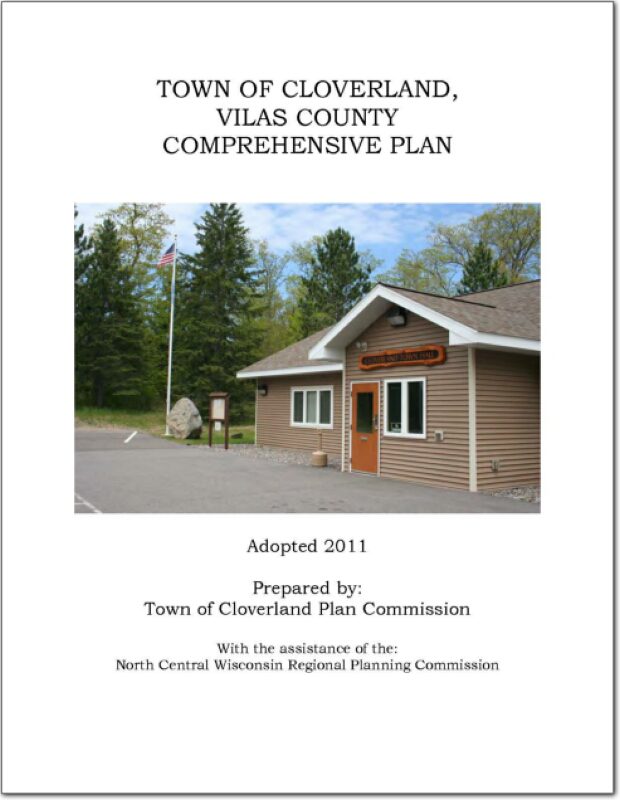
Town of Cloverland Comprehensive Plan 2011

The Town of Cloverland Comprehensive Plan, explores potential issues that may have an effect on the development of the Town over the 20-year planning period of the plan. As required by the state’s comprehensive planning law [§66.1001(2)(a) Wis. Stats.], this chapter contains trends and forecasts with jurisdictional comparisons for some basic demographics including: population, households, employment, age, education, and income. Although forecasts should typically cover the 20-year planning period, in some cases, the only acceptable sources had lesser time periods for their forecasts. Official sources are used for data and forecasting, including the WDOA Demographic Service Center, and the U.S. Census Bureau.